
British transport policy has been framed around economic growth for the best part of two decades. Almost every major transport scheme and every ministerial speech is justified by the promise of jobs, productivity, and prosperity. Growth is the stated objective. Yet it is worth asking whether the policy has actually delivered on that promise, or whether growth has functioned more as a label than as a discipline.
The honest answer is that the record is mixed at best. The transformative projects meant to reshape the national economy have been slow, expensive, and frequently truncated. The planning system has added years to delivery timelines, often for projects that were eventually approved or abandoned anyway. And where projects have been built, the economic benefits forecast in the business case have not reliably materialised. If transport policy is genuinely going to drive growth, it needs a clearer view of what works – and what doesn't.
We struggle to deliver the transformative projects that growth depends on
The UK’s inability to deliver major projects is well documented, and one transport project is the poster child of this: High Speed 2 (HS2). Conceived in 2009, HS2 was sold not just as a solution to capacity constraints on an at-capacity West Coast Mainline between London and Birmingham, but as the spine of a more productive national economy. At its maximum extent, it would connect many of the country’s largest cities and free up capacity on the wider rail network. The economic case rested heavily on the full Y-shaped network reaching beyond Birmingham to Manchester, Sheffield, Nottingham, and Leeds, because that configuration was what maximised the agglomeration benefits of bringing major cities closer together. The economic case of HS2 published in 2012 estimated economic benefits of £28.1 billion on the section between London and Birmingham, and £71 billion across the entire network
What happened instead is a case study in how not to deliver. Costs rose from an original estimate of around £32 billion to a range that the government now puts at roughly £88 billion to £103 billion. The eastern leg from Birmingham to Leeds was cancelled in the 2021 Integrated Rail Plan. The Birmingham to Manchester leg was cancelled in 2023, though Prime Minister in waiting Andy Burnham is seeking to revive this section. The first trains between London and Birmingham are now not expected until the late 2030s, with the full remaining scheme stretching into the 2040s. The benefit-cost ratio tells the same story in miniature. It was estimated at £2.40 of benefit per pound spent in early appraisals, was revised down to £1.80 by 2013, and the 2020 full business case put the overall programme at £1.50, with phase one alone graded as low value for money at £1.20.
Every delay makes the position worse for growth. As the Railway Industry Association and others have repeatedly noted, each element of cost rises every time the project slips, and constant uncertainty in government breeds uncertainty in industry, who in turn cannot plan their own investments. The benefits are pushed further into the future, while the costs keep climbing in the present.
The result is that a scheme originally justified as a growth project has shifted from a growth-first vision to a value-for-money rescue exercise. The cancelled northern legs to Manchester and Leeds were precisely the parts of the network expected to do the most to rebalance the economy, and their loss removed the strongest part of the original case.
HS2 is the obvious example, but it is not an isolated one. Leeds offers an even longer-running illustration. It remains the largest city in Western Europe without a mass transit system, and not for want of trying. A Supertram network was planned through the 1990s, approved in 2001, and then cancelled in 2005 by the then transport secretary after around £40 million had already been spent and the cost estimate had roughly doubled to around £1 billion. A replacement trolleybus scheme, New Generation Transport, was itself cancelled in 2016 after a further sum, reported at around £27 million, had been spent.
When the eastern leg of HS2 was cancelled in 2021, West Yorkshire was promised funding for mass transit as a consolation, and around £2.5 billion was later pledged. Yet the latest position by the National Infrastructure and Service Transformation Authority in late 2025 and early 2026 is that delivery has been reset again, with trams now unlikely before the late 2030s. A senior local councillor described the latest delay as déjà vu, drawing a direct line back to the cancellation of Supertram almost twenty years earlier. For a city whose economy and population have grown throughout this period, the cost of repeatedly starting and stopping is real.
The value of the growth forgone through these delays can be quantified. The think tank Centre for Cities has estimated that poor public transport connectivity in the five largest northern cities – Manchester, Leeds, Sheffield, Liverpool, and Newcastle – costs the economy more than £16 billion a year in lost productivity, because more than four million people cannot reach their city centre within thirty minutes by public transport. Separately, the Government’s own framing of Northern Powerhouse Rail notes that lifting productivity in the major northern cities to the national average could add up to £40 billion a year to the UK economy. These figures describe an ongoing annual loss, not a one-off. Every year that transformative capacity is delayed is a year that this output is not recovered.
Planning and judicial review add years before a spade goes in the ground
The second problem sits upstream of delivery, in the consenting process itself. The canonical example is Heathrow Terminal 5. The planning application for the new terminal was submitted in February 1993. The public inquiry that followed ran from May 1995 to March 1999, sitting for 525 days, and remains the longest planning inquiry in British history. The decision to approve was not made until November 2001, and the terminal did not open until March 2008. From application to opening took around fifteen years, and from first conception in the 1980s the timeline stretches towards two decades. At the time, even supportive MPs described the four-year inquiry, and the years of delay around it, as something that should never be allowed to happen again.
The lesson was supposedly learned, and the Planning Act 2008 created a dedicated regime for Nationally Significant Infrastructure Projects (NSIPs) intended to speed things up. Yet legal challenge has become a recurring source of delay. The A303 Stonehenge scheme is a notable recent illustration. Development consent for the tunnel and dual carriageway was first granted in November 2020, against the recommendation of the Planning Inspectorate. That decision was quashed by the High Court in July 2021 on grounds relating to the consideration of alternatives and the adequacy of information before ministers. The scheme was redetermined and approved again in July 2023. It was challenged again, the challenge was dismissed in the High Court in early 2024, campaigners were then granted permission to appeal, and in July 2024 the Government announced it would not proceed with the scheme at all. The net result of more than three years of legal process was a project that was approved twice, litigated repeatedly, and ultimately abandoned.
The aggregate picture is striking. In a written statement in January 2025, the Government reported that 58% of decisions on NSIPs had been subject to legal challenge in recent years. Of 30 challenges brought against major infrastructure projects, only four had resulted in a decision being overturned. On average each legal challenge took 1.4 years to conclude, the courts had spent more than 10,000 working days handling these cases, and major road projects had paid up to £121 million per scheme as a consequence of delays in legal proceedings. In other words, the overwhelming majority of challenges did not succeed, but they imposed substantial cost and delay regardless.
It is right that the public can test the lawfulness of government decisions, and judicial review is an important safeguard. The problem is not that challenges exist but that the process has allowed meritless or repetitive claims to delay projects of national importance with little ultimate effect on the outcome. The Planning and Infrastructure Act 2025 has begun to address this, reducing the number of attempts a claimant can make to bring a legal challenge, and the Government has set out target timescales for these cases in the High Court and Court of Appeal. These are sensible reforms. But they also confirm the diagnosis. For years, a process intended to ensure good decisions has functioned as a brake on delivery, and a growth-oriented policy cannot tolerate timelines measured in decades.
We cannot be confident the forecast economic benefits will actually appear
The third problem is the least visible but arguably the most important. Even when projects are delivered, the economic benefits set out in their appraisal often fail to materialise as forecast. This matters because the entire system of prioritisation rests on those forecasts. The Department for Transport’s appraisal framework, Transport Analysis Guidance, produces benefit-cost ratios that determine which schemes are judged good value and therefore which get funded. If the forecasts are systematically optimistic, the whole basis for allocating capital to growth is compromised.
The evidence that this happens is reasonably consistent. National Highways runs a structured programme of Post Opening Project Evaluation (POPE), comparing the actual impact of major road schemes one year and five years after opening against what was forecast. The meta-analysis of these evaluations found that observed traffic flows were generally lower than predicted. Individual scheme evaluations tell the same story. The widening of the M27 between junctions three and four, for example, delivered lower than expected journey time savings as a result of lower than forecast traffic volumes, and its outturn benefit-cost ratio came in below the figure used to justify the scheme.
This is not a peculiarly British phenomenon. The academic literature on transport appraisal, most prominently the work associated with Bent Flyvbjerg, has documented a persistent pattern in which costs come in higher and benefits come in lower than predicted at the appraisal stage. One ex-post study of road projects in Denmark found that actual traffic volumes were on average around 7% lower than forecast, a bias that is statistically significant and matters a great deal for congested networks, where benefits are highly sensitive to traffic levels. HS2 is again instructive. Its falling benefit-cost ratio over time, as costs rose and the network shrank, shows how much the headline appraisal figure can move between the decision to build and the reality of delivery.
The point is not that appraisal is worthless or that every forecast is wrong. It is that a policy genuinely oriented towards growth should treat appraisal forecasts with appropriate caution, invest far more in measuring what schemes actually deliver, and feed that evidence back into future decisions. At present, the gap between forecast and realised benefits is large enough that confident claims about the growth impact of any individual scheme should be read sceptically.
If the record is as patchy as the evidence suggests, the obvious question is what a genuinely pro-growth transport policy would look like instead. The answer is that it should be organised around mobility. The economic value of transport comes overwhelmingly from connecting people to opportunities, jobs, customers, suppliers, education, and from connecting businesses to one another and to a larger pool of workers. This is the mechanism behind agglomeration – that better-connected labour markets are more productive. The number of opportunities a person can reach in a reasonable time is therefore the right lens because it is the thing that actually drives growth, rather than speed or capacity for their own sake.
Several priorities follow from putting this at the centre.
Fast and frequent inter-urban travel matters, but the need varies by region
Connecting cities to one another quickly and reliably expands the effective labour market and allows firms in different places to trade ideas and services. But the case for investment is not uniform across the country. The British network is comparatively good at north-south journeys to and from London and comparatively poor at the east-west journeys between cities in the North and the Midlands. For example, travelling between Birmingham and Nottingham by rail takes around one hour and fifteen minutes to cover a distance of just over fifty miles. Meanwhile, from Birmingham to London, a distance of one hundred and twenty miles, takes just one hour and nineteen minutes by rail.
The North is the clearest example of where the gap is most damaging. While four fast trains an hour run between Leeds and Manchester, two of the largest economies in the country, this hides some serious structural deficiencies. These services are often overcrowded, with trains often running with fewer carriages than timetables, and trains taking three-quarters of an hour to cover thirty six miles. Compare that to services running between London and Peterborough, which take around the same time to cover seventy-four miles.
The Northern Powerhouse Rail Partnership has estimated that a line linking just Manchester, Leeds, and Bradford could add around £22 billion in gross value added to the northern economy and raise productivity in those cities by up to 6%. The contrast with Scotland’s Central Belt, where better connections between Edinburgh and Glasgow have helped pool the labour market and support productivity growth, shows what is possible when dense urban areas are properly linked. Investing in fast, frequent inter-urban connections is therefore a real growth lever, but the priority should be the corridors where the current offer is weakest and the agglomeration potential is greatest, which means east-west connectivity in the North above almost anything else.
High-quality urban public transport is essential, and trams and metros should be its backbone
The most consistent finding in the evidence concerns travel within cities rather than between them. Centre for Cities has shown that, on average, only around 40% of people in Britain’s big cities can reach the city centre within thirty minutes by public transport, compared with roughly 67% in comparable European cities, such as Copenhagen and Munich. The comparison between similarly sized cities is stark. In Leeds, fewer than four in ten people can reach the centre in thirty minutes, while in Marseille it’s close to nine in ten. British cities are consequently economically much smaller than their populations suggest, because a large share of their potential workforce simply cannot reach the centre quickly. This is why poor urban connectivity, rather than poor inter-city links alone, sits at the heart of the productivity gap.
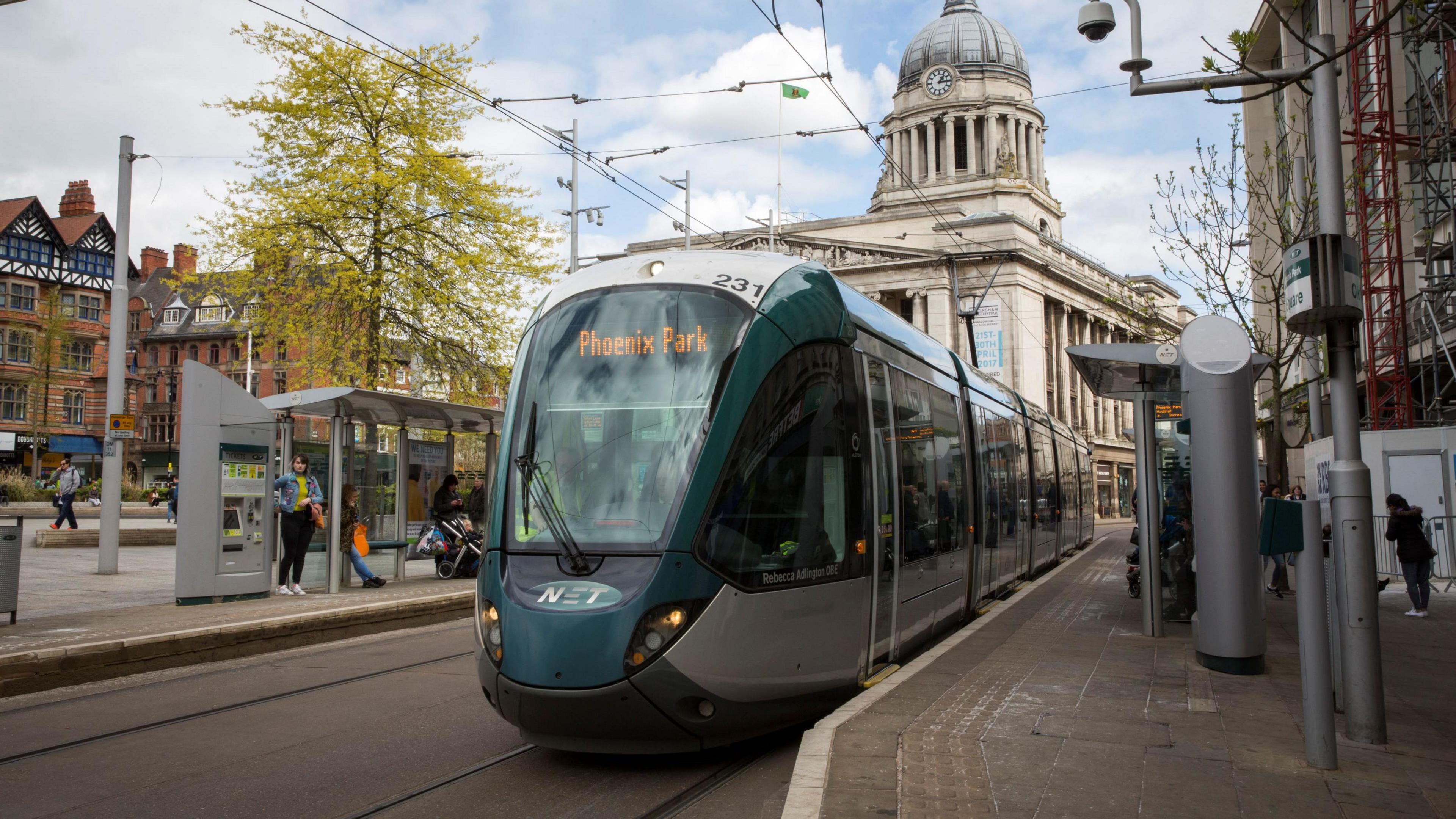
Trams, light rail, and metro systems should form the backbone of urban networks, because they offer the capacity, reliability, and attractiveness that high-frequency travel into dense centres requires. The successes already exist and are instructive. Manchester’s Metrolink, the Tyne and Wear Metro, the Nottingham Express Tram, and the West Midlands Metro have all demonstrably reshaped how people move and where they can work. The problem, as the Leeds story shows, is that Britain has been chronically bad at delivering these systems, and it builds them at far higher cost than comparable European cities.
This is precisely the gap the Government’s new Mass Transit Taskforce, launched in 2026 and chaired by Bridget Rosewell, is meant to close. Bringing together expertise from transport, planning, finance, industry, and academia, it has been asked to identify the barriers in planning, financing, and land acquisition that slow these schemes down and to recommend practical reforms, with initial recommendations expected within months. It sits alongside the £15.6 billion committed to Transport for City Regions in the 2025 Spending Review. The right ambition is not simply to fund these networks but to accelerate their delivery, so that cities stop spending decades planning systems that are then cancelled. Building the routes is necessary but not sufficient. The evidence also shows that the low-rise built form of British cities means fewer people live close to transport, so denser housing around stops and stations is part of the same agenda.
Roads matter, but economic gains often come through unexpected routes
Investment in roads remains important, particularly for freight, for areas poorly served by rail, and for journeys that public transport cannot realistically replace. But a pro-growth policy should be clear-eyed about where the economic returns from transport investment actually come from, because the intuitive answers are often wrong.
The clearest example is the relationship between car access, free parking, and the health of high streets. Retailers consistently believe that most of their customers arrive by car and that free or convenient parking is essential to footfall and sales. The evidence does not support this. A widely cited study of two shopping streets in Berlin found that only around 7% of shoppers had arrived by car, against the roughly 22% that traders estimated, and that more than 90% of takings came from people who walked, cycled, or used public transport. A review of commercial centres in Greater London reached a similar conclusion, finding that retailers vastly overestimate the role that free parking plays in their success.
The positive case is set out in the Pedestrian Pound research published by the charity Living Streets, most recently updated in 2024. It finds that people who walk to the high street tend to spend more over a week or a month than those who drive, that streets where the pedestrian experience has been improved have seen footfall rise by around 20-35%, and that well-designed schemes can lift retail sales by 30% or more. The implication for policy is important. Some of the most cost-effective ways to support local economic activity are not large road schemes at all, but relatively cheap improvements to walking, public realm, and the quality of place. A growth strategy that defaults to road capacity and free parking as the way to help town centres is likely to be spending money in the wrong place.
Define and measure
Finally, a policy needs metrics that measure success and failure. Too often, transport investment is judged by inputs and outputs that are easy to count, miles of road, billions of pounds committed, or by forecast benefit-cost ratios that, as set out above, are not reliably borne out.
Two metrics deserve to sit at the centre instead. The first is the number of people who can reach key economic hubs, principally city centres and major employment sites, within thirty minutes. This directly captures the size of the effective labour market and therefore the agglomeration benefits that drive productivity. It is also actionable. Centre for Cities has estimated that better integration of existing networks in England’s next six largest cities, through aligned timetables, integrated ticketing, and faster, more frequent buses, could connect around 1.2 million more people to their city centres within thirty minutes and boost national output by an estimated £17.4 billion a year. That is a larger and more certain return than many headline capital schemes, and it flows from improving mobility rather than simply adding infrastructure.
The second metric is reliability. A service that is fast on paper but frequently late or cancelled does not expand the effective labour market, because people cannot depend on it to get to work on time. Reliability is consistently undervalued in appraisal and underweighted in public debate, yet it is central to whether a network actually delivers what it promises. The unreliability of TransPennine Express services are a standing example of how poor performance shrinks the practical reach of a network well below its theoretical reach.
Rhetoric not reality
So British transport policy has called itself pro-growth for years. But its record suggests the label has run ahead of reality. The transformative projects meant to reshape the economy have been slow, costly, and cut back. The consenting process has added years and, in some cases, has delivered nothing for the delay. And the benefits forecast in business cases have too often failed to appear once schemes are built.
A genuinely pro-growth policy would start from a different place. It would treat the number of people and opportunities that can be reached in a reasonable time as the organising objective. That means prioritising fast and frequent inter-urban links where the current offer is weakest, especially across North England. It means building high-quality, reliable, and attractive urban networks with trams and metros at their core, and delivering them far faster than we have managed to date. It means recognising that some of the best economic returns come from cheap improvements to the public realm rather than from road capacity. And it means measuring success by how many people can reach economic hubs quickly and reliably, rather than by how much has been spent. Growth has been the stated goal for a long time. This is how a transport policy would actually achieve it.
James Gleave is the Founder and Director of Mobility Lab UK. He writes regularly on his Substack, Mobility Matters.
Looking for Growth do not necessarily endorse the opinions expressed in this article. Opinions are the authors only.
