
What happens when a few ordinary people stop complaining about Britain's problems and start trying to solve them? If you've ever looked at something in your community and thought "surely we could do something about that", we'd love for you to get involved.
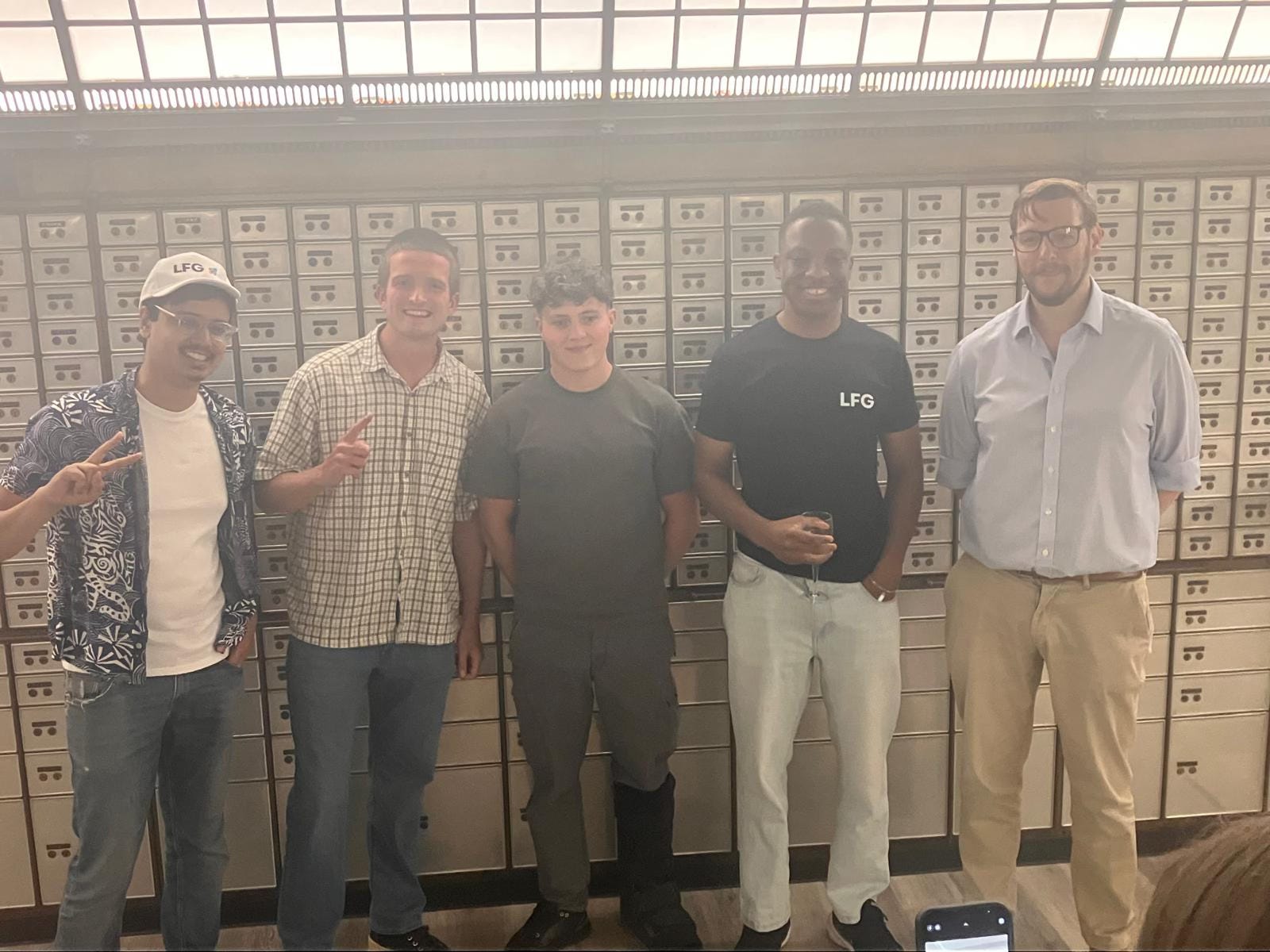
It started, as many good British ideas do, in a pub. I was about to meet a group I’d heard plenty about but had never actually met: the West Midlands chapter of LFG.
What greeted me wasn’t quite what I had imagined. A ragtag collection of blokes, sitting around having a pint. Just ordinary guys. I pulled up an uncomfortable chair, introduced myself and quickly joined in with what appeared to be the evening’s main activity: laying into the Government and discussing everything wrong with Britain.
There were no grand speeches, no funding, no strategic plan and certainly no expectation that we were about to change the West Midlands. Just a few guys, a few pints, and a shared frustration with the state of the country.
And to be fair, there was plenty to be frustrated about. The trouble was that, for all our enthusiasm, we weren’t exactly doing much about it ourselves. We were getting rather good at discussing Britain’s problems over a pint. But we wanted the chapter to be more than that.
Where the hell should we start?
Our first answer was rather unglamorous.
Litter.
Anyone living in Birmingham will know that rubbish hasn’t exactly been in short supply. So we organised a few small clean-ups, tackled some fly-tipping and, on one particularly memorable occasion, went to considerable effort to get rid of an abandoned fridge.
Hardly the stuff of the Industrial Revolution. But it was a start. We had gone from talking about problems to actually doing something about them, however small. And that got us thinking. If a few ordinary people could organise themselves to improve their neighbourhood, what else might we achieve?
Because that’s what makes LFG interesting. It’s not an organisation of people with limitless resources, enormous amounts of spare time, or some special mandate to change the country. It’s largely ordinary people with busy lives, jobs, families and other commitments.
People who have decided that complaining about Britain’s problems isn’t enough. The question was how we could take that attitude and apply it to something more ambitious.
For inspiration, we didn’t have to look very far. The West Midlands, after all, helped give birth to the Industrial Revolution. Our canals connected factories, workshops and markets across the nation, while Birmingham became the City of a Thousand Trades. The region was home to the Lunar Society, whose inventors, entrepreneurs and thinkers helped transform Britain and the wider world.
And this isn’t just nostalgia. The West Midlands really was one of the great engines of national prosperity. In 1961, Birmingham had the highest household income in the country, while Coventry was the fastest-growing city in Britain. Under Joseph Chamberlain’s civic gospel, Birmingham was widely seen as one of the best-run cities in the world.
For a time, this was one of the great centres of innovation on the planet. Today, those conversations are more likely to conjure images of Shenzhen or San Francisco.
So what happened?
In part, our decline came from a mix of poor national industrial strategy, the mishandling of our industrial strengths, and a centralising state that steadily stripped municipalities of the power to build, invest, and shape their own futures. And the things we still lack are strikingly familiar: better transport connectivity, a large enough economic core, and the investment infrastructure to unlock growth.
But here’s the thing. The West Midlands is still the only UK region recognised as having strengths across all eight of the growth-driving sectors the Government is backing through its Modern Industrial Strategy. From advanced manufacturing to creative industries, the ingredients for growth are already here. We may have lost some of our economic dynamism, but we certainly haven’t lost our potential.
But what if we could rekindle a little of that spirit? What might a 21st-century Lunar Society look like?
We started wondering what would happen if we brought together people with different skills, gave them real regional challenges, and encouraged them to build solutions.
And that’s how we arrived at the idea of a hackathon. In May, we hosted our first LFG West Midlands public-good hackathon at The Exchange in Birmingham.
We brought together developers, students, entrepreneurs, policy enthusiasts, and others who simply wanted to make a difference. The challenge was straightforward: identify problems facing the West Midlands and build something that might help solve them.
By the end of the day, we had something rather more interesting than another set of recommendations.
We had working prototypes.
The three winning ideas were simple, practical and rooted in the region:
Ask Ozzy – an AI-powered civic intelligence platform making Birmingham’s public data easier to explore and use.
Solar-to-Industry Private Wire Mapper – a tool identifying where local solar power could be connected with local manufactures by private wire to reduce high industrial energy costs and grid constraints.
Warwickshire and West Midlands Integrated Travel App – a prototype helping people connect transport options across the wider regional economy into Warwickshire.
Three different problems. Three different ideas. Three working prototypes. All developed by people who had come together voluntarily, many of whom had never met before.
We had gone from pints to prototypes, and suddenly, things started moving rather quickly.
There is, however, a fairly obvious problem with hackathons. They’re great fun. Everyone gets excited. People build impressive things. Somebody wins a prize, everyone takes a photograph and then, all too often, the projects quietly disappear into a forgotten GitHub repository. We didn’t want that. So rather than treating May’s hackathon as the finish line, we started asking how we could take the strongest ideas further.
Our solar-to-industry project has helped inspire work on a regional white paper exploring how greater local energy generation could reduce costs for West Midlands manufacturers and strengthen our industrial base.
Our transport project has prompted further thinking about how to improve connectivity across the wider regional economy, including places like Warwickshire that are vital to its growth.
And we’ve continued developing Ask Ozzy, bringing together hundreds of Birmingham datasets into a platform that could help residents, businesses, and decision-makers better understand their city.
The idea behind Ask Ozzy is deceptively simple. Our public bodies hold enormous quantities of information about the places we live, yet much of it remains difficult to find, understand or use. What if that wasn’t the case?
With AI, building a civic engagement platform like this is becoming dramatically more accessible. Work that once demanded significant budgets and specialist development teams can increasingly be attempted by small groups with the right skills and determination.
Of course, a hackathon prototype is not a finished product. But the fact that we’ve been able to build and keep developing these ideas, largely through voluntary effort, should make us question what else might be possible.
And why stop at one hackathon? We’ve started developing partnerships with organisations that have real-world problems they want to solve, including plans for a regional hackathon focused on advanced manufacturing.
The ambition is to create a repeatable model: bring together businesses, students, technical talent, and enthusiastic volunteers; identify genuine challenges; build solutions; and help the most promising ideas develop beyond the event itself.
Not every idea will work. Some probably shouldn’t. But if even a handful become useful products, services or campaigns, that’s a pretty remarkable return on a few people’s spare time.
Today, we’re taking another step. As part of Birmingham Tech Week, we’re bringing people together for Brum Builds with AI, where we’ll showcase Ask Ozzy. We’ll also be inviting them to build things themselves, and because of AI, you won’t need to be an experienced programmer. You won’t need a venture capital fund. You just need a problem worth solving and a willingness to have a go.
We’re also exploring how we might transform the rather depressing pedestrian connection between Birmingham New Street and Moor Street stations into something that celebrates our region’s potential rather than reminding people of its problems.
A hackathon, a few promising projects and some enthusiastic volunteers aren’t going to reverse decades of economic underperformance. We’re well aware of that.
But this isn’t really just an article about what LFG West Midlands has been doing. More than that, it’s about the most interesting ingredient in this story. The People. Specifically what can happen when ordinary people decide they don’t need to wait for someone else to make things better where they live.
Across the country, LFG chapters are bringing together people who want to rescue Britain. Here in the West Midlands, we’ve found our own way of contributing. We’re people with jobs, families, busy lives and plenty of other things competing for our attention. We don’t have all the answers, and we’re making much of this up as we go along.
But we’ve adopted a fairly simple attitude: we can just do stuff.
We can bring people together. We can build things. We can experiment, fail, learn, and try again. And slowly, we’re starting to make a difference.
Now imagine if more people did the same. After all, we started with a few blokes in a pub, complaining about why Britain doesn’t build things anymore. Now we’re building things ourselves. And we’re only getting started.
So if you’re frustrated with the state of things, come and join us. Bring your ideas, your skills, or just your enthusiasm.
We might even buy you a pint!
Isaac Vivian is the Captain of LFG West Midlands.