
The name Dr Richard Beeching is one that is synonymous with decline and retrenchment in transport circles. His 1963 report The Reshaping of British Railways signalled the closure of railways across the United Kingdom. It is estimated that over five thousand miles of track, and over two-and-a-half thousand stations fell under the Beeching Axe.
Yet here I am talking about a railway that Beeching did not recommend be closed, but was closed anyway. In his report, Beeching recommended that passenger services operating between Oxford, Bletchley, and Cambridge over what has since come to be known as the Varsity Line instead be modified. The track would still remain in place, but services that had just been converted into diesel trains be retained with some small changes in service patterns. Clearly the Doctor recognised the value in connecting the UK’s historic universities directly by rail.
Too bad British Railways did not see it the same way.
The ink had hardly dried on Beeching’s Report when British Railways put the line forward for closure in December 1963, citing the fact that the service barely covered half of its costs from ticket sales. Three years later, just before football came home, the closure was confirmed. Local freight facilities immediately closed. A branch line to Buckingham was closed by the end of that year. The next year, the line between Bicester and Oxford was closed to passenger trains, and the section west of Bletchley made freight only. In 1968, the line between Bedford and Cambridge was closed, and ultimately pulled up.
A determined local campaign saved the passenger service running between Bedford and Bletchley, which has subsequently survived other closure attempts, and still runs to this day. This campaign, fought by local people who did not want to lose their local train service, probably saved the railway completely. And that is important because it is now at the centre of what could potentially be one of the most transformative infrastructure projects in the UK.
If only we would actually build it.
The East-West Rail project ultimately wants to reinstate a railway that even Dr Beeching did not think was worth losing. At its core is upgrading and building new infrastructure to run passenger train services between Oxford and Cambridge, serving places such as Milton Keynes and Bedford along the way. But the campaign to reopen it was started by somewhere not even close to the line.
In 1995, Ipswich Borough Council was concerned about the state of passenger trains operating east to west in East Anglia. Along with partner local councils, it established the East-West Rail Consortium who, in the early 2000s, started work on the business case in earnest. Over the years, more business case work was undertaken by the consortium to build the case for reopening the line. Finally, in 2011, the Department for Transport decided to adopt the scheme as a priority, and a year later confirmed the scheme as part of its strategy for rail.
Now, in a normal country, you would expect the line to be open by now, and the whole Oxford to Cambridge Arc be benefitting from the uplift in growth you would expect to see, right?
Right?
Let’s start with the good news. The first section between Oxford and Bicester was re-opened in 2016 as part of Chiltern Railways’ Evergreen Project. A regular passenger service runs along the line between Oxford and London Marylebone via the Chiltern Mainline, and at the time Chiltern Railways agreed to make “passive provision” for the rest of East-West Rail to be delivered. The service has been very well used, particularly to and from Bicester. In fact, in a unique quirk, Bicester Village is the only station in the country where announcements are made in both English and Mandarin, such is its popularity with Chinese tourists who use it to get to Bicester Village shopping centre.
After a long time in planning, the Transport and Works Act Order was granted for the Western Section – between Bletchley and Bicester – and work started in 2020. The track work was completed in 2024, and since that point, freight trains have been able to run over the route.
That’s where the good news ends. Despite being in planning for nearly thirty years, and being government policy for fifteen, the region still awaits trains.
Starting where we left off on the Western Section, despite the track being laid and even a new station at Winslow completing construction, passenger trains are still not running. The cause of this problem is frustratingly simple: Driver Only Operation. Rail unions are locked in a disagreement with the planned operator, Chiltern Railways, over the insistence that the new service be operated with only a driver on board, and without a conductor. While it is tempting to think of this as unions delaying a scheme by defending their members, they may have a point here. Many groups, such as women, feel safer using public transport with a visible official presence on board – something that a conductor provides.
Local sources say that, after over a year of impasse, agreement has been reached between the train operator and the unions on this matter, and all are working to start services between Milton Keynes and Oxford via Bletchley in December 2026. As of the time of writing, this has not been officially confirmed by the Government.
If the Western section has been a frustrating story to read, it is nothing compared to the Central Section. Designed to bridge the gap left by the removal of the railway between Bedford and Cambridge, it has become a poster child of process over outcome.
The East West Rail Company, created by the Department for Transport to deliver the plans for East West Rail developed by them, Network Rail, and the East West Rail Alliance (the current name of the East West Rail Consortium), has spent nine years and countless millions developing the designs and the case for the Central Section.
The current proposals will see fifty miles of new track constructed. This is alongside a number of station improvements and some new stations.
Bedford. An upgraded station, including a new western entrance, intended as a new gateway providing connectivity in all directions. Once complete, up to four trains per hour would serve Bedford from the west.
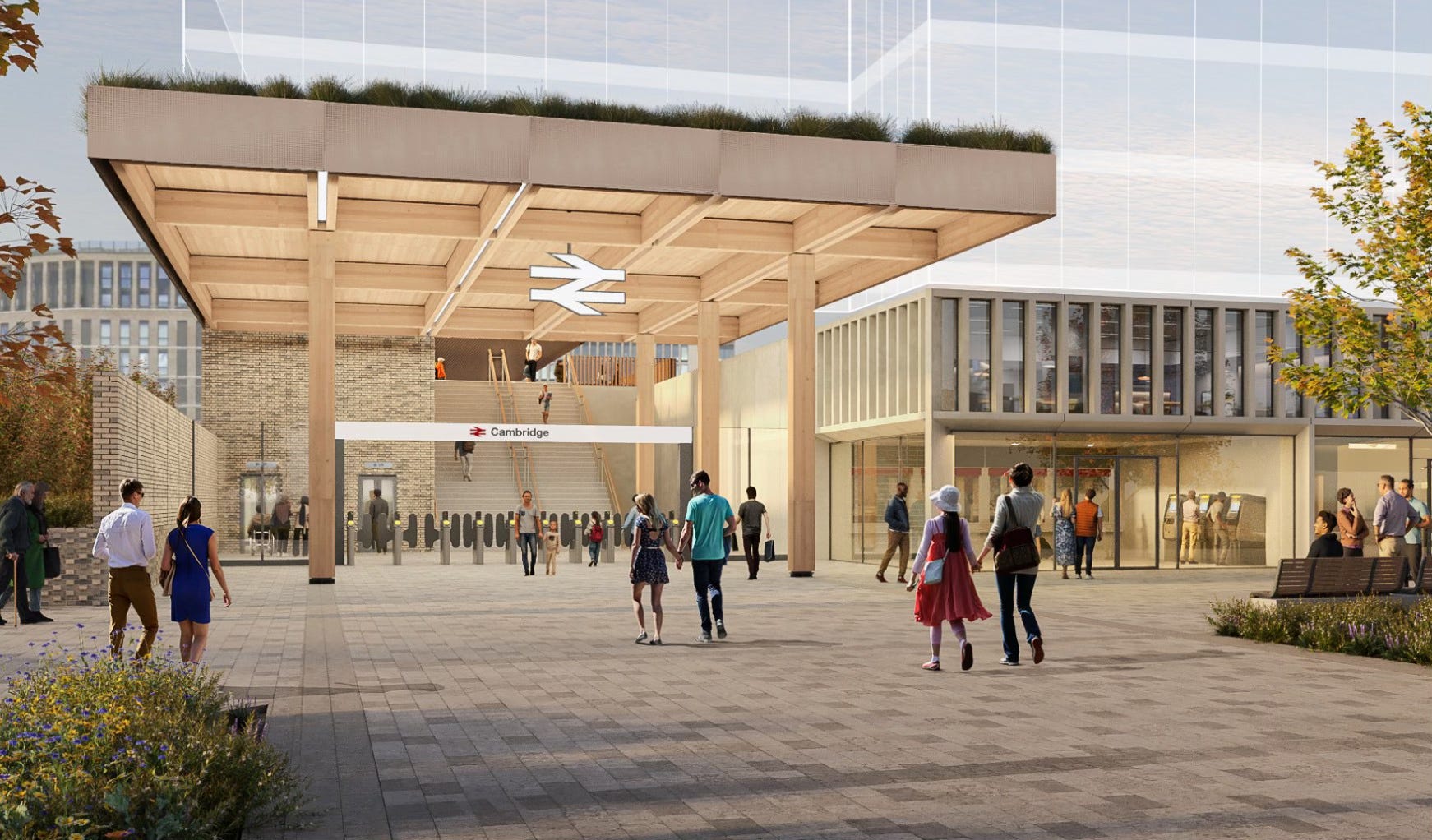
Cambridge. The plans show a new Clifton Road entrance on the eastern side with associated station and driver facilities and an Active Travel Hub, along with an extension of platforms 7 and 8, a new Platform 9, modifications and extension to the station footbridge, a new southern footbridge, and two new tracks to the west of the existing West Anglia Main Line. A realigned A1134 Long Road overbridge is also proposed.
Tempsford (new station). To serve the planned new town, and provide an interchange with the East Coast Mainline just to the north of Sandy in Bedfordshire.
Cambourne (new station). To serve the villages to the West of Cambridge.
Cambridge East (new station). To serve new development to the East of Cambridge and provide a terminus station.
The proposals will also speed up journey times on the Marston Vale Line by rationalising the existing ten intermediate stations between Bedford and Bletchley to just four – at Woburn Sands, Ridgmont, Lidlington, and Stewartby. More on the latter later.
To date, there have been four consultations on the Central Section. A consultation on Route Options in 2019, the consultation on Making Meaningful Connections in 2021, a non-statutory consultation on updated proposals in 2024, and a consultation in 2026 described by the Company as the final engagement before it submits its plans for a Development Consent Order. That in itself has a statutory consultation process also.
What exactly are we waiting for?
The frustrating thing is that there are clear and obvious benefits to East West Rail becoming a reality. Benefits so obvious that it taking so long is both comical and downright negligent.
Today, travelling between Oxford and Cambridge by public transport is a joke. Two of the most famous university cities in the world, separated by around eighty miles, are barely connected by public transport. Catching the train between them involves going via London on a trip that is nearly two and three-quarter hours long. If you don’t fancy changing in London, you can always travel by bus, changing at Bedford Bus Station, which is a delightful experience. That is at least two and a half hours. Meanwhile, if the drive sounds tempting, that is two hours on a good day, which is unlikely as the A421 through Oxfordshire and Buckinghamshire is the most direct route, and is a heavily-trafficked single carriageway road.
With East West Rail, that journey time drops to ninety minutes. Direct. It’s not only Oxford and Cambridge that benefit either, as Milton Keynes and Bedford will also see rapidly sped up journeys and all the towns along the way. East West Rail will be a 100mph long distance version of the Elizabeth Line, linking all the towns across the arc.
This means a researcher in Cambridge can collaborate with a lab in Oxford without losing a day to the journey. Milton Keynes and Bedford are then positioned at the heart of this growth corridor, rather than just being bypassed. The railway brings several hundred thousand more people within commuting distance of both Oxford and Cambridge. Places like Bicester, Winslow, Tempsford and Cambourne go from being off the map to being on it.
Then there is the economics. The Oxford to Cambridge Growth Corridor already generates around £143 billion in gross value added every year, across a population of roughly three and a half million people. Nearly a third of the jobs in the area are in knowledge-intensive sectors, close to triple the British average. It is one of the most productive parts of the United Kingdom, and one of the few places in Europe that can credibly be spoken of in the same breath as Silicon Valley. This is precisely why successive governments have reached for that comparison, and East West Rail will be a catalytic new cluster for dynamic economic growth.
The problem is that the region’s transport has never matched its ambition, and East West Rail is the piece designed to fix that. By 2050, the Government’s own figures expect the railway to boost the regional economy by around £6.7 billion every single year. It is expected to support up to 100,000 new homes, connecting new and established communities to jobs, training, and education.
This is not just jobs or houses either. To the south of Bedford, the new Universal Studios is being constructed just to the South East of the existing Marston Vale Line. Currently under construction, it is forecast to general millions of visitor trips to the region each year. And the station at Stewartby – repositioned just to take advantage of this new theme park – is critical to its plans to prevent gridlock on the region’s roads.
Then you get onto the freight. Freight trains are already using the section of line that has been opened, and when the Central Section comes online, its role in moving freight will be supercharged. It could replace millions of lorry journeys a year and cut carbon emissions from moving goods by up to three quarters. That means fewer lorries on the A14, A421, and A428.
The strange spectacle of fighting your own good fortune
Yet despite all of these benefits, as sure as night follows day, there are a substantial number of people across the line of the route who have demanded this once-in-a-generation opportunity not be delayed, but be stopped in its tracks. The present be preserved at the expense of the future.
Let’s start in Bedford. A place that will have a substantially improved station and will see four trains an hour heading off to the likes of Cambridge and Oxford. Yet local opposition is forming to stop this. BFARe, which stands for Bedford For a Re-consultation, argues that the 2019 consultation was flawed and that the chosen route through the heart of the town is the wrong one. Alongside it, the Protect Poets campaign says it speaks for residents of Bedford’s Poets area, where a number of homes stand in the path of the alignment and face demolition.
Their lobbying is now holding sway. Bedford Borough Council, who for a long time unequivocally backed East West Rail, has now started to harden its position. At an extraordinary full council meeting on 27 May 2026, members unanimously approved a more robust response to the 2026 consultation. The environment portfolio holder, Cllr Nicola Gribble (Independent), characterised the proposals as fundamentally flawed and ill-fitting, memorably calling the scheme a square peg in a round hole and questioning how Bedford would function during construction. The Conservative group leader, Cllr Graeme Coombes, pushed successfully to make the response more robust, stating his group could not support anything requiring home demolitions and arguing the Council should consider withdrawing support altogether if concerns over demolitions, noise, and disruption were not addressed.
Travel to the Cambridge end and the pattern repeats. In South Cambridgeshire, the group Cambridge Approaches has become the standard-bearer for opposition to the southern approach into the city. They argue it is poor value for money, and warn that the railway is a Trojan Horse for yet more housebuilding in the area.
These two campaigns have delivered a joint Declaration of Opposition to the rail minister in person, signed by members of parliament, parliamentary candidates, the chairman of Cambridgeshire County Council, the mayor of Bedford, and councillors at county, district, borough and parish level. They have run petitions, and dominated the local debate on the project.
Everyone is entitled to their opinion, obviously. We live in a democratic society, and people should have the right to have their objections heard. But scrutiny and obstruction are not the same thing.
While declarations, petitions, and protest are loud, support is often silent. The four regional chambers of commerce along the route (Thames Valley, Milton Keynes, Bedfordshire, and Cambridgeshire) support the scheme. So do many local MPs such as Chris Carter (Milton Keynes North) and Daniel Zeichner (Cambridge). It has been backed by six Prime Ministers. While local councils may argue about minor changes to the scheme, all are broadly supportive of it. The Universities support it, as do local sustainable travel groups. Finally, the East West Rail Company itself estimates that around seventy percent of local residents along the route support the scheme.
Which makes the fact that the project is still being delayed, and that the opposition is so vocal, all the more frustrating. If it’s this hard to build something that commands such support, imagine what it would be like if it was universally opposed.
NO MORE NONSENSE. JUST BUILD IT.
The Looking for Growth Milton Keynes, Cambridge, and Oxford Chapters are working together to ensure that support for the scheme remains in the public consciousness. Our message is simple: this scheme needs to be approved, constructed, and opened without delay.
Too much work has been undertaken for too long to delay any further. We do not say this because the concerns of residents do not matter. We say it because this scheme has been subject to extensive democratic debate and has overwhelming support.
The Development Consent Order process is built to weigh environmental impact, to require mitigation, to compensate those whose property is affected fairly and properly, and to test the scheme in public. All remaining matters affecting the delivery of the railway are matters of delivery, and not reasons to abandon it. Every one of them can be managed by a project that is allowed to get on with it. None of them is improved by another decade of paralysis, or yet another consultation.
Any further delay has a cost to it: in economic growth forgone; in cars on congested roads whose drivers could take the train instead; in homes not built or jobs not created; in lorries on the road when that cargo could be being hauled behind a freight locomotive; and in the fact that two of the finest knowledge centres in the world do not have a direct train service between them.
The frustrating thing is that, in a way, this scheme is not an improvement. It is fixing a historical mistake. A railway that Dr Beeching himself, a man whose name is synonymous with closing railways, explicitly did not think should be lost, was closed anyway, in an act of short-term accountancy that the region has regretted ever since. It took British Railways three years to decide to shut it. It has now taken the best part of thirty to decide to open it again. And still we wait.
It’s time to end the delays and build the railway. The case has been made, the money has been committed, the benefits are enormous, and the mistake it corrects is nearly sixty years old. It cannot be held up any longer. Our future prosperity depends on the technologies of the Fourth Industrial Revolution – AI, computer tech, and biotechnology – in which places like Oxford and Cambridge excel. We cannot afford to lose out.
We spent three years deciding to close this line and thirty deciding whether to reopen it. If he were alive today, Dr Beeching would probably be confused about it all. It is time to finish the job.
James Gleave is the Founder and Director of Mobility Lab UK. He writes regularly on his Substack, Mobility Matters.
