
It was a Sunday morning, and I was on my long run. My route took me along the edges of Oxfordshire where new housing developments are currently under construction. Normally I would take this as a win for the YIMBYs, myself included, but the soullessness of these new homes saddened me. Dramatically angled roofs, monotone grey frontages, miniscule windows – how was this building for the future?
England pioneered architecture: Christopher Wren, Robert Adam and John Nash moulded our beautiful towns and cities. It is something we are rightly proud of and that tourists travel from across the world to visit.
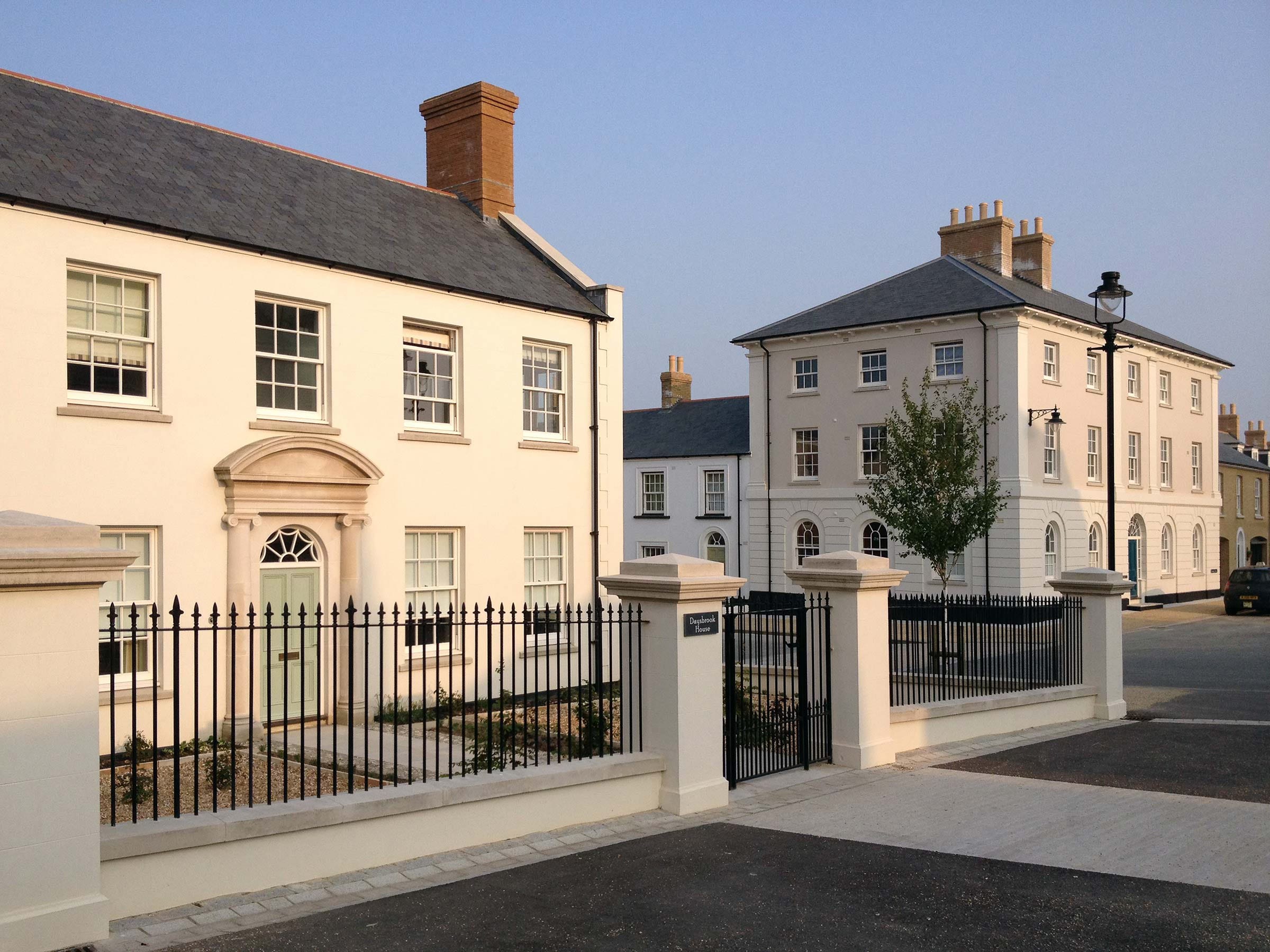
Whilst we may watch the patronising Kevin McCloud on Grand Designs marvelling over another grey box in the middle of nowhere, what the people really want is a return to a Georgian heyday. Indeed, three quarters of the public name Georgian as their favourite housing style, whilst two thirds believe that modern designs suffer from a “lack of character”.
These Georgian properties have some key hallmarks that make them so distinctive: they are five to six stories tall, and include sash windows, iron railings, steps up to the house, and a stucco-frontage. It is this stylisation that is so distinctive, so reliable and thus so replicable. As the architectural historian David Lewis said, they can be “mass produced… to an extent that is true of few other styles”.
So, if this is such a simple, popular solution, why are we not using it?
The answer, like many such cases, is over-regulation.
Take sash windows, for example, the prime victim. Whilst they may encourage natural ventilation throughout the home, and offer bountiful light (supplementing anyone’s vitamin D intake), they are deemed energy inefficient. New property developers are encouraged to build homes that can keep as much heat in as possible, thus resigning its inhabitants to tiny windows to minimise escapage, and as a result often leading to black mould growing.
However, even earlier, a 1990s moral panic sought to ring the first death knoll for the sash window. The fear of children fatally defenestrating themselves led to the John Major-led government mandating that window openings on the first floor and above must be higher than 1.1 meter from the floor. Yet, such a policy, combined with energy efficiency and minimisation of building costs, results in lower ceiling heights and thus smaller windows too. This panic is disproportionate: 2 children died per year between April 2019 to May 2025 from falling out of windows (and of course there is likely to be nuance as to how and why such incidents happened). In short, our British tendency to risk-aversion has stymied us to dark, ugly houses.
What about the iconic steps up to the house, that create such a distinction from public and private space? Well, step-free access is required, so that’s a no go.
The very shape therefore of our houses is again constrained by regulation. Georgian townhouses are tall and thin. Yet, the minimum widths for stairs and corridors, combined with energy efficiency and cost saving tactics, have widened our new housing estates, leaving them to squat toad-like across the landscape.
Thus, when NIMBYs complain about the amount of land being taken up by such developments, surely the simple solution is to build denser: building up, as the Georgians did well. In fact, it is largely due to a lack of building densely in our major cities that we have urban sprawl and ‘infringements on the countryside’. London has just half the housing density of Paris – hardly ideal when we have such great demand to live in our capital, and resentment from those who opt for the long commute as a result. This densification would help to lower prices, maximise land, and protect our much beloved countryside.
Yet another complaint often levelled against YIMBYs is that new properties are often not in keeping with their local area. On this, the NIMBYs may very well be correct, but only as a result of deliberate regulatory choices.
Indeed, the Government already publishes a ‘National Character Areas’ guide, which divides England into 159 distinct areas – each defined by a unique combination of landscape, biodiversity, geodiversity, history, cultural, and economic activity. Most interestingly though, is that it also includes the traditional building materials used in different areas – the key to making a building ‘fit in’ to its neighbours.
Take the north Norfolk coast: it has a distinctive brick and flint style, with pantiled roofs, whilst in Manchester you’re more likely to see a red brick, or in Cambridge the gault clay bricks used produce a distinctive yellow-grey colour. If we utilised this information, which we already have, and produced pre-approved housing styles for respective regions, we could allow compliant housing developers to build these houses without the need for local planning acceptance, which often causes massive delays.
Poundbury is often heralded as the ideal, the aspiration to aim towards, adopting this Georgian style, and gentle density, that people want to live in, Yet, that development too had to oblige with the same painful planning regulations as the rest of the country. As such they utilised loopholes, like having steps up to the front door but a side step-free access, or sash windows that only opened from the top not the bottom, to prevent the imaginary children falling out.
However, of course, these exceptions were incredibly expensive and are not replicable on a mass scale. Therefore, what we need is greater deregulation of these archaic planning laws: if someone wants bigger windows and higher ceilings, then they must accept that their energy bill may increase. Likewise, if a parent of a young child is genuinely concerned about them falling out of a window that is less than 1.1m from the ground, then they can opt for another house.
Why have we created a housing system that endeavours to cater to all and mitigate risk to the detriment of actual building taking place? Surely we are better off having more homes and more choice than a system in which there are so few homes it is too expensive to buy a property until you are in your late 30s. We want to see a nation in which homeownership is not a distant fantasy but a near aim, a return to being a “nation of homeowners”.
We should be building homes for the future, not for the current political weather. The solutions already exist; we have no excuse for not getting on with it.
Harriet Dolby is a Parliamentary Researcher in the House of Lords, former President of the Oxford University Conservative Association, and an undergraduate student at the University of Oxford
Looking for Growth do not necessarily endorse the opinions expressed in this article. Opinions are the authors only.
